/Vimond-symbol-name-white-blue.svg)
OTT stands for over-the-top and refers to video content streamed directly from a streaming service to consumers. Dive into this OTT guide to learn more about video and online streaming, and the basics for getting started with an online streaming service.
A guide to OTT and getting started with streaming
OTT is a streaming media service that delivers video, audio, and other content directly to viewers over the Internet. Examples: Netflix, Hulu, Disney+, Binge, etc.
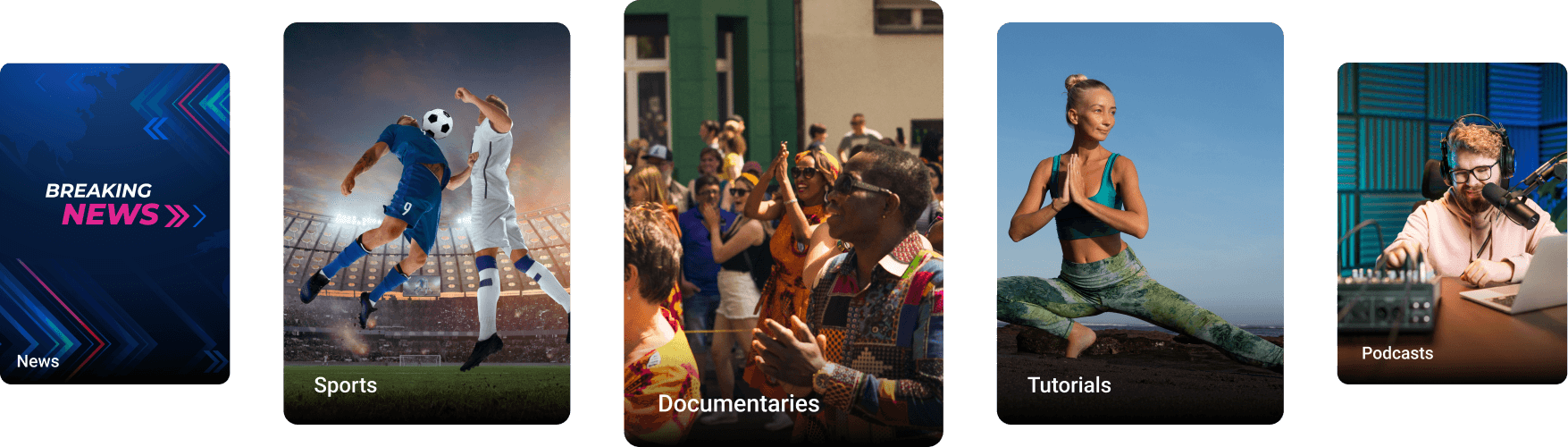
The OTT term is most commonly used for streaming video, but it also applies to streaming music and voice-calling apps delivered over the Internet.
An important aspect, hence the name OTT, is that it bypasses the "normal" distributors and goes directly to consumers. Over-the-top plays on the analogy of bypassing the traditional Set-Top-box (STB).
For broadcasters and content creators, an OTT platform offers a direct relationship with consumers outside the traditional cable TV universe, enabling a more personalised TV experience as viewing patterns can be better tracked.
This guide covers the basics for:
- What is an OTT platform?
- The components of an OTT platform
- How to start a streaming service
What is an OTT platform?
Today, there are many OTT platforms, such as Netflix, Hulu, Disney+, and Amazon Prime, in addition to the national broadcasters, local TV, news publishers, and local streaming services. The common denominator for OTT platforms is that video content is available to end consumers anytime, anywhere, on any device. The services are usually funded through monetisation models such as AVOD, SVOD, and TVOD. You can dive into OTT Monetisation in this Guide to OTT Monetisation.
Many traditional linear broadcasters, local and national, worldwide, have also launched digital channels or OTT services. With this, it is possible to reach audiences on the move or those who may engage with the content on a laptop or mobile device rather than on television.

The components of an OTT platform
Running an OTT platform can be complex and involve several components. From a high-level view, someone looking to run an enterprise-grade OTT platform usually considers the following components:
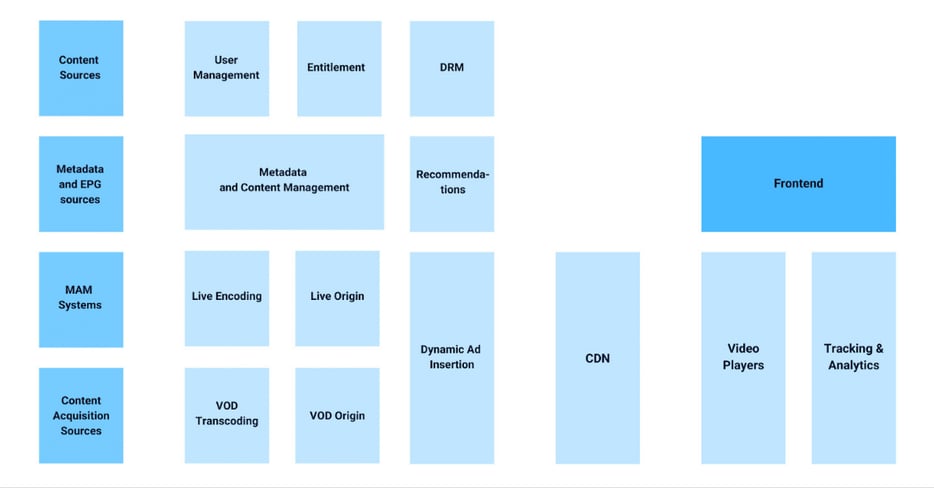
Does this feel daunting? Getting started with a streaming service doesn't have to be this complex!
We have built Vimond Essentials for anyone looking to get started with online video and streaming, without the need for developers, integrations, or complex workflows, and to launch a streaming service in a matter of days. From local news, live events, documentaries, training videos, studio podcasts, and any other content, both live and recorded, you can manage your assets, stream from web, iOS, Android TV and mobile, and Apple TV, and earn money on your content from the one unified streaming platform, Vimond Essentials.
Video hosting and transcoding
To make your video files available for user playback, they need to be hosted and transcoded. Video hosting is the process of uploading your video content to a server so it's available online, while video transcoding ensures the video files are accessible and packaged in the right formats for the correct devices.
With the Vimond video and streaming solutions, we enable users to retrieve content files, transcode them, and package them into a range of formats suited to your viewer devices and at different bitrates. Learn more about the Vimond technology here.
CDN
CDN, short for Content Delivery Network, is a global network of servers that speeds up the delivery of content over the internet. For a streaming service to work smoothly, it's vital to have a CDN provider close to users so videos load faster.
Examples of CDN providers
AWS Cloudfront, Akamai, Lumen and Fastly, to name but a few. Many of the larger OTT and digital content providers will have several CDNs, either to tune performance in certain areas so that viewers get better experiences, with lower latency, fewer interruptions, and less judder in their digital streams. In addition, several CDNs provide resilience and redundancy to ensure continued operation in the event of network interruptions or data transfer issues.
CDN and content protection
An important aspect of a CDN is content protection. Content protection can cover several areas. Starting with geo-blocking and location restrictions. There are both simple and advanced ways for OTT providers to restrict content access based on a viewer's physical location. This can be achieved at the continental, country and local level. Solutions range from basic protection to more sophisticated measures that can help restrict access to content from people trying to bypass geo-blocking rules using services such as VPNs. Advanced solutions are available.
Content protection is a hot topic. Content providers and companies running OTT services need to know that only paying customers have access to the content. Content protection is a complex area and can include measures against hackers and others who try to disrupt and capture live streams for sporting and other events, or to redistribute content without proper licensing arrangements.
DRM - Digital Rights Management
DRM, short for Digital Rights Management, is a technology that controls and manages access to copyrighted video content. DRM encrypts your files and protects your files from copyright infringement.
In addition to the above types of protection, many OTT services need to adhere to rules defined by the content creator or owner, such as a maximum limit of concurrent streams that can be viewed at the same time from the same user account or the number of devices that can be associated with an account at any one time.
Video content management system (Video CMS)
A Video CMS plays a crucial part in running an OTT platform. A video content management system enables editorial teams to manage video assets by adding metadata and structuring content into categories displayed in the streaming service's front-end applications.
The video CMS plays an important role in the end-to-end OTT workflow, providing status overviews and integrating with various vendors throughout the value chain.
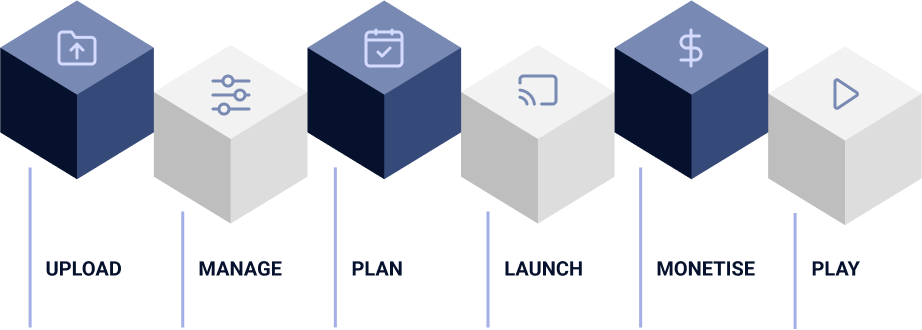
Learn about the Vimond video CMS and streaming platform here.
Monetisation
When you run a streaming service, you want to generate revenue from the content you serve. You need a tool that can monetise your video content. Monetising your video content means you make end users pay, usually through a monthly subscription, to access it. There are several monetisation modules to choose from, including AVOD, SVOD, and TVOD. Learn more about the monetisation models in this Guide to Monetisation.
Front-end players
In the streaming world, “Front-End” is a broad term that covers everything from web portals, IPTV Apps to traditional Mobile Apps (iOS & Android).
Front-ends are a crucial part of any OTT service and must be easily accessible and engaging for the end-user. Front-ends consist of many functions, but the primary ones are content visualisation and end-user display in an engaging, visually appealing format, payment gateways, and a video player.
With solutions, such as Vimond Essentials, the front-end builder is integrated into the platform for a seamless workflow from your content upload, categorisation, adding metadata, building the video carousels, "up-next" etc., to building the front-end applications for web, mobile, Apple TV, etc.
Content Recommendations
To create a great viewing experience for the users, content recommendations should be included. If a user is given too many choices, deciding what content to watch can be tiring. The last thing you want is to lose subscribers due to the abundance of choice.

The best content recommendations let you tailor your content to end users' preferences, or you can create lists of "most-watched content," "the latest content," and similar.
Analytics
Understanding what is happening on your OTT platform is the key to success.
Analytics can help in many ways. One of the key elements of a successful OTT platform is the audience experience. This means measuring latency and stream quality for end users. Videos should start on the viewer´s screen as quickly as possible after play is pressed or the content is unpaused. The stream should always be of the highest possible quality or bitrate to ensure your audience enjoys the content at its best.
In addition to operational analytics for stream quality and technical success, analytics can be used to understand viewer behaviour, content demand, the popularity of catalogue items, and audience segmentation, supporting the making of good recommendations.
As part of our video CMS, we offer analytics features to monitor player stats, website analytics, and app information. Having data from your streaming services helps you build a clearer picture of your audience, enabling you to develop insights and measure your service's success.
How to start a streaming service
In the OTT industry, there is no one-size-fits-all solution. However, finding the right partners and components does not have to be difficult. In Vimond, we offer solutions for getting started with streaming, from basic to advanced, and tailored platforms, with no need for in-house development teams and for fast setup and publishing of your streaming service.
-
Take a look at our Solutions Comparison Guide here.
- See this short blueprint for launching a streaming service.
Ready to build and launch a successful streaming service, where you can earn money on your content? Book your free discovery meeting with our team here.
👉 We hope you found this article useful. Don’t hesitate to get in touch with us with any questions or to book an introductory meeting.